Tuesday, August 24, 2010

Mauthausen

I’m struggling with what to say about visiting a Concentration Camp for my first time. First off, it’s funny to think about asking somebody, was this your first time assuming there would be more visits. In that question I start scrutinizing myself wondering if I had reacted in the correct way. On the way there I was afraid of the emotions I would feel I wondered if I would loose it emotionally—would I weep uncontrollably or become furiously irate? How is one supposed to react in a place of 200,000 murders?

I prepared for this excursion by re-reading my underlined portions of Ruth Kluger’s book Still Alive and Adolf Frankl’s Art Against Oblivion. I have Ruth Kluger running through my brain: “the missing ingredients are the odor of fear emanating from human bodies, the concentrated aggression, the reduced minds.” I also have the images of Adolf Frankl’s life in Auschwitz imprinted in my mind. Through his art, I see the agony, horror and torture the Holocaust inflicted upon this man (and countless others). In his painting The Crematoria, he talks about the stench of burning flesh. I decide I will breathe deep when I walk in and take notice of the smells

We drove over a bridge with railroad tracks on our way to Mauthausen. Were these the same train tracks that Eichmann used to transport the prisoners? Then we drove through the quaint little town of Mauthausen. It seems like a sweet, innocent and classic little Austrian town. As we reached the top of Errinerung Strasse (Memory Street) and arrived at the camp I first looked at the view from the top of the hill. It was a beautiful view of the whole entire town resting peacefully below. I wondered if the prisoners were able to see the freedom below as they lived through their hell on earth. Then I wondered if the town below could see the camp and if they knew the atrocities committed in their town’s quarry. Then I wonder if I would have known if I lived in Mauthausen in 1941. Then I wonder if I would have done anything even if I had known.


Inside the camp I don’t smell any unusual odors. The air is crisp and fresh.


On our tour we make our way to the Memorial Garden. I find myself irritated as I have to stay with the group and listen to the tour guide. She asks us questions about what we think the monuments mean, and have a volunteer from our group read quotes of survivors and details of the Holocaust’s horrors. I want to get away, not because I can’t handle the information, I’ve read more and plenty more gruesome details before. I resent being tied to a group of people as I walk through the grounds of the death camp where thousands were murdered. I turn around and find myself staring at a pile of stones climbing up the giant Menorah, the memorial to the Jewish victims. I’m caught off guard, as tears well up in my eyes and my chin quivers. I grow more upset: because of the rain in Vienna I left my sunglasses at home. Now it’s hot and sunny and I have nothing to cover my eyes and I can’t let these strangers see me cry, I never cry, my boyfriend has only seen me cry a handful of times and we’ve known each other over six years. My God I’m petty. I gain composure and stick with the group (at my own pace).

We enter into a long discussion about Das Experiment, the German film based on the Stanford prison experiment (http://www.prisonexp.org/). The experiment uncovers how easily ordinary citizens opt to commit crimes against humanity when under the direction of someone in charge. This is similar to Hannah Arendt’s argument in The Banality of Evil. The Holocaust death machine was not run by armies of psychopathic SS men, but by ordinary citizens. I find myself surrounded by 30 ordinary citizens: a few Jews, a few Conservatives and a lot of Liberals. I wonder about how we would fit into the dynamics of perpetrator, bystander, and victim. Would any of us have opted for resistance? Next we enter the prisoner camp.

The inside of the barracks smell old and musty.

The last place our tour guide takes us in the gas chamber. We see where the zyklon b gas was fed into the cement chamber. Then less than 30 of us cram into the tomb where 80-100 walking skeletons breathed their last breath, contaminated with a lethal dose of pesticide. I wonder about Ruth Kluger’s father and his elbows. I look at the walls and the door: the last structure 200,000 inmates scratching, clung to hoping to breakthrough for fresh air. Fresh air for them however being coupled with the stench of burning flesh and the ashes of the prisoners that died before them.

I smell my fellow students: hints of flowery shampoo, perfume and cologne.

My thoughts are interrupted by the sobs of some of my classmates. I walk through the door, counting my steps to the gate: 282. As I stare out the gate all I see is the Menorah straight ahead and the Memorial Garden that replaced the SS officers barracks. I don’t know how many more steps it would have taken make it out of the main gate. Two-hundred-and-eighty-two would have only led me face to face to those coerced into the banality of evil. The futility astounds me. There were 200 ‘stairs’ down into the quarry. Those however have been re-modeled to make it safer for the camp visitors. It was nothing like it was for the prisoners. There was no blood. There were no bodies. There were no prisoners. I had snacks in my backpack in case I got hungry and a sweater in case it turned cold.

The air smelled fresh but hot. I can smell the water in the pond at the bottom of Parachute Wall.

At dinner on our way home to Vienna in Waidhoffen we talk about Mauthausen, the Holocaust and the Jews. The discussion turns too depressing for dinner conversation when we get onto the topic of other atrocities occurring today. We arrived at this when discussing the difference of the Holocaust versus Shoah. Is it a cycle of tragedies or one event? Others wanted to happily drink their wine and beer. I could talk about it all day. Bystanders did not talk about. We did not even face the fear of death, or worse, by talking about it. Today at the camp I learned of an SS officer who was pardoned. When asked about his actions he replied “I can’t believe people could do such things.” The interviewer replied, “You did this.” He could not even admit reality. He could not talk about it. I do not have the officer’s name and could not find his story. It is on my list of things to do.

It rained with thunder and lightening on our way home. Our bus did not sing on the way home from the alps, but we sang on the way home from Mauthausen: Queen’s Bohemian Rhapsody among other less epic songs.

Monday, August 23, 2010

Leopold Museum


We were fortunate enough to be a part of the return of Wally to Vienna’s Leopold Museum. Leopold, the personal owner of the Museum’s collection of art loaned Wally for exhibit in New York. While on loan, its original owner who claimed it was stolen from their family during the war came forward to fight for the painting’s return. After years of court and a rather large payout, Leopold bought the painting for a second time. for $19 million. Here is a news article about Wally's return. I also looked for a video of the news wondering if I was caught as a bystander. I was in fact there for the unveiling of Wally, the second half to Schiele's self portrait. It turns out there are a couple of ways to own so much art. One you can be like Leopold and "eat bread instead of schnitzel" or you can commandeer it like the Nazis.


The story of the life and travels of this painting are quite interesting. It is amazing how art gets tangled up in a World War, and not just any war, but with Hitler's war. It is fascinating how Hitler was denied acceptance into Vienna's art school and Vienna's architecture school and he goes on to steal art and to murder millions. Once again I am prompted to insert a film:


Looking at his art, I do not think it sucks, it is by far better than anything I can do. However I am only an amateur art critic and only do so in my spare time. It does enrage me a little bit reading the comments on the youtube post of Hitler's Art. The question, "how would the world be different if Hitler got into art school" is in fact unanswerable. Not that I have not questioned the question myself, because I have pondered it often. It is just appalling to see that so many ignorant youtube commentators blame the art critics for Hitler's Holocaust and World War success, not to mention the other anti-Semitic comments as well.


When it comes to critiquing art, Klimt knows the pain of being rejected as an artist. Gustav Klimt was commissioned to paint four panels for the University. The University however did not like the completed art and that was the end of Klimt's work on the Ringstrasse projects. While the critics rejected Klimt, no matter how eccentric of a man he was, he did not resort to mass murders.


Sunday, August 22, 2010

Rewind: Jewish Vienna Walking Tour I & II

I took two walking tours of Vienna that began at Schwedenplatz right outside the McDonalds. Our guide began the tour by informing us about the tour in Vienna’s Bermuda Traingle, where tourists get lost in the bars.

The first documented Jew in Vienna’s history. Schlomo the master minter was the first Jew in Vienna in the thirteenth Century who handled the money Vienna collected from King Richard the Lionheart’s ransom. Returning crusaders however killed Schlomo on their trek home.

We were taken to the house, where the first Jewish family lived during the fourteenth Century In 1400 there was “some kind of a ghetto” built in the Leopoldstadt with the eruz walls. In 1671 Leopold expelled the Jews under the influence of the Spanish Inquisitions and the urging of his Spanish wife and who blamed the Jews for her four miscarriages. Then in 1870s Jews gained some rights in Vienna under the Tolerance Laws of Josef II.


Next we were taken to the Stadttempel. It was built under the toleration acts of Josef II, which regulated that any non-Catholic Church must not be seen from the outside. It is the founding synagogue of a choir led by Schöbert. Because of its hidden location, it was the only synagogue to survive the November Pogrom of 1938, suffering only occupation, pillaging and ransacking by the Nazis. In 1945 Rabbi Löf from Prague reactivated the Synagogue as a Jewish house of worship. Also in 1948 the synagogue held the exhumed body of Theodor Herzl, the founding father of Zionism, before his remains were brought to Israel for burial and final resting place. He was originally buried after his death in 1904 in the Döblinger Friedhof, in his parent’s grave.


Next on tour was the kosher corner. Kosher laws require the separation of meat and dairy. Representing this kosher law are the stores for meat and the bagel and cream store on opposite corners of Seitenstettengasse and Judengasse. It was the Kosher and cleanliness laws that kept the Jews slightly cleaner than other non-Jews, which resulted in a few less deaths during plague years. Jews were hence blamed for causing the plagues and suffered increased persecution.

After that we proceeded to the Niemals Vergessen memorial at the Gestapo house. The memorial is built on the adjacent corner of the location of the Gestapo house, which was destroyed during allied air raids in 1945. The Gestapo House was originally Das Hotel Metropol, a hotel owned by a Jew and confiscated by the Nazis in 1938. Seven hundred Nazis worked in the former hotel. The apartment house built to replace the destroyed Gestapo Hause ordained with a plaque to remember 1945 and the end of the cruel Nazis.

The memorial here was built to remember the political and Jewish victims of fascism. It was built of stones dug out of the Mauthhausen Labor Camp by its prisoners. There is a statue of a single prisoner to represent Austria’s resurrection, wiederauferstanden, from death and hell. There used to be an iron bar across the front that represented the homosexual victims but it has been removed as a form of protest, because the homosexual victims wanted their own memorial. Thence then established a mobile memorial (which I would like to find out more about, the guide could not expound on it).

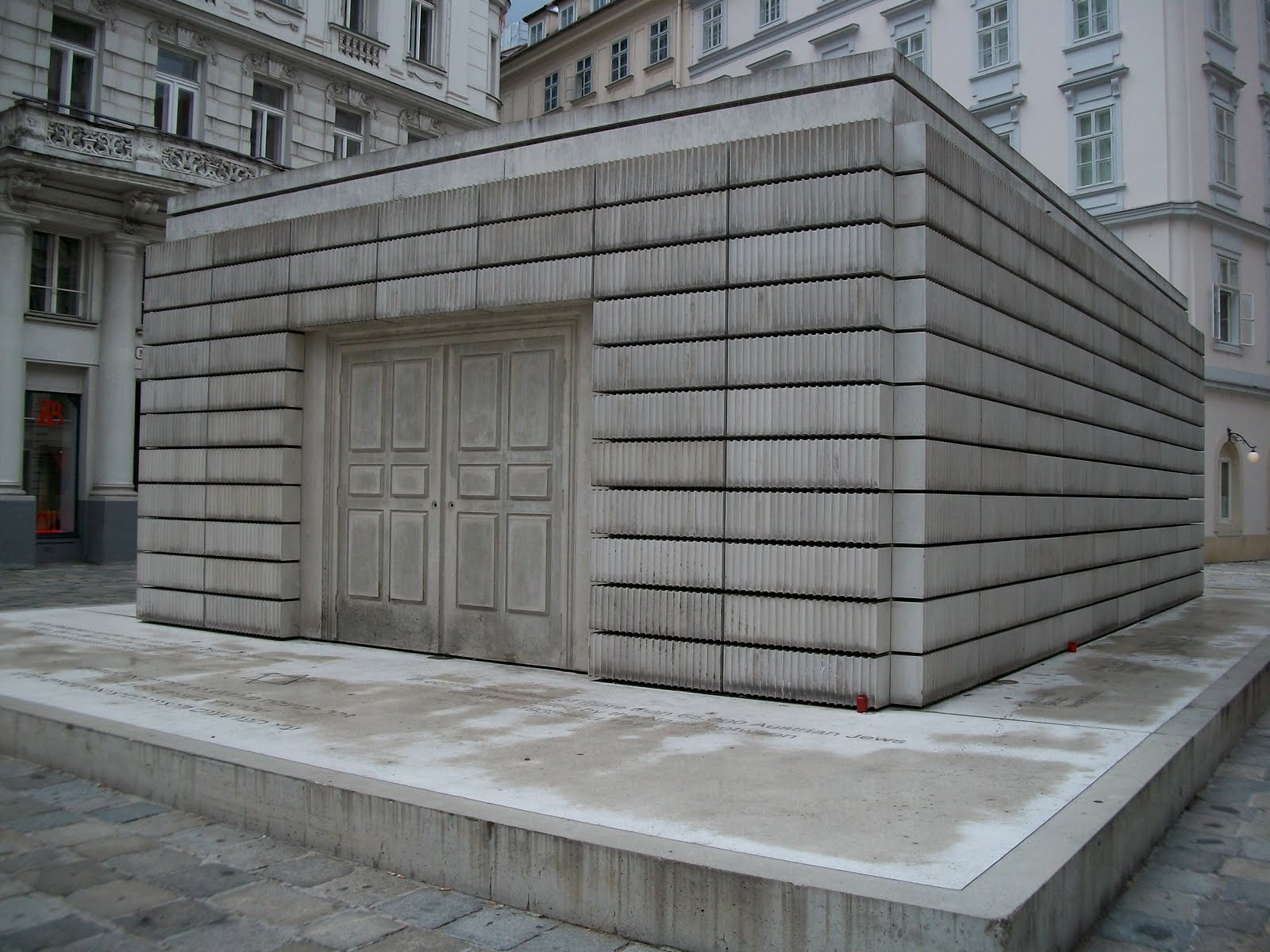
The difference between the tours takes us from here to a different part of the city. One takes us to Judenplatz, the other across the Danube Canal to Leopoldstadt. In the Judenplatz we find the Resistance Archive close by, Rachel Whiteread’s Memorial to the 65,000 murdered Austrian Jews, the Art Forum and Lessing, the man on tolerance. The other tour takes us to Weg der Erinnerung. This second tour is a tour of plaques that mostly commemorate buildings, synagogues and people that are no longer in existence—victims of fascism. The copper plates of the Memory’s Way number over 120 (and always increasing) throughout the city, mostly in Leopoldstadt, One of the plaques is in a schoolyard, the Nazi’s used this schoolyard as the meeting place for Vienna’s Jew just before deportation. The headmasters of the school do not like the constant memory of Vienna’s cooperation with the Nazis and had it covered with the bike rack. An American complained to the city of Vienna and now the school must keep it viewable and accessible to viewers. The controversies of memory are very interesting: some are ashamed to remember and want to forget and others need to remember to gain closure.

Saturday, August 21, 2010

Tour de Danube

Hands down the best day in Austria was not in Vienna but along the River Danube (and I’ll even have to knock hiking in the alps down to number 2). This Saturday, five of us (Kathy Stuart, Harrison, Richard, Sarah and myself) ventured to Krems with our rented bikes and then pedaled our way along the Danube to Melk.

The 41 km (over 25 miles) tour de Danube was perfection. The hills were alive with the music in my head and the terraced vineyards rolling up the hills. Where sidewalks would have been poured, vines of grapes met the road with rosebushes interspersed to flavor the wine just right. The cyclist could reach out a grab a bunch of grapes directly from the vine if one was so inclined.

As we ventured along the Danube we came across Dürnstein. On the top of the hill overlooking the quaint town is the actual fortress that held King Richard the Lionheart and crusader in 1192. Leopold V, after a dispute with England’s King at the siege in Acre, took the opportunity to kidnap the Lionheart in disguise while attempting to return home after crusading. Richard was later released when England raised the ransom through “ruinous taxes.” It is a grand story and even grander of a story for me to say, “I rode by Richard the Lionheart’s prison on a bike ride along the Danube.”

This was not the only castle on the hilltops along the Danube. Every couple of kilometers there was another castle, ruins or something of historical significance. In one city we stopped by a church. Its foundations were built on a pagan site of worship that dated back to the 800s. The church hosted a wedding, so we did not go inside but the church had a spiral staircase in the back of an unattached tower behind the church and its small cemetery. The top was open and overlooked the Danube and the town. There was an information plaque at the top that mentioned an altar made out of skulls. The cellar it was contained in at the bottom of the tower was closed but it was viewable through the windows. Not once in all my life had I imagined an altar built out of stones would exist and that I would have the chance to see it.

Besides being welcomed by castles and interesting churches from Austria’s hillsides along the Danube, we were also welcomed by another aspect of Austira’s rich culture: Heurigen. As we grew hungry from our tour we could stop for a glass or two of this years wine and fill our bellies with a snack of authentic Heuriger food: bread and cheese spreads. The delicacy is called Griebenschmalz, which is a rendered fat with crunchy pieces of pork mixed in and spread over bread. I can tell you the bread was tasty, while others I dined with could expound on the deliciousness of the non-vegan fare.

We arrived in Melk by crossing the Danube over hydro-electric plant after the miles of the Danube trails up and down hills, through towns and over a few unpleasant cobblestone streets. My fondest memories of this trip is soaking my feet in the cool Danube and listing to the “wahoos” from a fellow traveler as we coasted down the hills with the wind in our hair. As we caught the train home, I couldn’t help but decide that if I had a choice I would ride my bike along a river like this every Saturday for the rest of my life. It is a shame I forgot my camera.

Friday, August 20, 2010

Schatzkammer und Kaisergruft


Schatzkammer displays the majesty of the Habsburgs kings. The jewels on the crown of this dynasty are a reminder of the wealth, power and prestige that the Habsburgs flaunted. Even the baby’s crib puts all other cribs to shame. While the Habsburgs were the faces of the empire, there were hordes of people who ran the household and the court and changed the babies’ diapers. The court, which was the power behind the scenes that ensured the crowns were polished instead of wearing them, were not defined as the court but “as a family extended to include all persons who were called to serve it.”[1]

The Treasury displays its most valuable pieces and I found that the exhibits here really helped me recognize the difference between Gothic and Baroque styles. Many of the Gothic pieces, which date before the 1600, are mostly black and have very intricate designs. The Baroque is more like a sunburst that stands out because of its grandeur and gold. The Treasury has the pieces labeled with dates so it makes it easy to place the artifacts on a timeline and see how they change through styles of the centuries.

While the Schatzkammer holds the evidence of the Habsburgs life, the Kaisergruft holds the evidence of their death. The Kaisergruft is in fact the resting place for the remains of Habsburgs themselves. If the crown had any indication of their wealth, the Emperor’s Tomb made sure to immortalize their power and prestige after death. The Habsburgs’ coffins are by no means any ordinary coffins, but they are massive and decorated with skulls and crowns. The most spectacular is Marie Theresia, who is on top of her casket seated with a sword in her hand and a Cherub giving her an eternal crown. Also, close by us a stone replica of her earthly crown and other pieces that are similar to those on display in the treasury. It makes sense that someone who resided in Schönbrunn just for the summer would need something spectacular for Austria to mourn the loss of its Empress. Being in the cool tomb where the Holy Roman Emperors of Germany are laid to rest was not only eerie but pretty awesome.


[1] John P. Spielman, The City and the Crown, 53.

Thursday, August 19, 2010

Wien Stadt Museum

The Wien Stadt Museum is an incredible museum that is very nicely organized and small, which makes it quite concise and easy to through in one visit. Even though it is small in size, its exhibits are far from lacking. Each of Vienna’s main events in History are accounted for and my visit to this museum really helped me review everything I’ve been learning in Vienna.

I loved the medieval exhibits of the Gothic the stained glass windows. Instead of being high up in the far away windows of a church, the museum Gothic’s stained glass windows were at eye level, close enough to touch if I so dared (but I didn’t). It was incredible to see the lead outlines and the construction of the glass. The colors were also so vibrant with the details of shading illuminated with a backlight. It is amazing the time, skill and effort the master guilds put into one section of a windowpane. It also astounds me when a fragile artifact such as glass survives throughout centuries intact. The stained glass is indeed some of my favorite pieces of art.

Another fascinating piece of Art in the Wien Museum is a 17th Century painting Christ Before Pilate. Pilate was the governor charged with keeping the peace when Jesus was on trial, accused by the Jewish priests and elders. He questioned Jesus and repeatedly found no fault with him but the Jewish community was on the brink of riot over the fate of Jesus. Pilate did not want to crucify Jesus and had even offered to release one prisoner—Jesus or Barabbas—which was the custom. It was a choice like do you want chocolate chips or glass in your cookies, the Jews, of course, chose glass. Pilate washed his hands of their choice and the Jews said, “His blood shall be on us and our children.” Barabbas was set free and Jesus crucified. (Matthew 27:11-26; Matthew 27:25 NASV Bible).This painting depicts the point when the Jews decided to murder the innocent Jesus Christ instead of a convicted felon and murderer. The hypocrites rejected their law of eye for an eye and demanded the blood of not just any innocent man, but the Son of God and the Virgin Mary. This is anti-Semitic enough without the inscription of the text in the lower left, “With this bloodthirsty trial and judgment, thus did the godless Jews behave and treat Jesus the Saviour of the world. How such was found in Vienna under the earth, hewn of stone.” This anti-Semitism depicted in the 17th Century painting resulted in the expulsion of Jews from Vienna in the same time span under Leopold I.

Besides the stained glass and Jewish relevant art, I also found the Turkish wars collection quite fascinating. The Relief Battle, a representation of the Polish forces joining Prince Eugene to save Vienna in 1683 against the Turks, shows the bloody battle with decapitated Viennese victims as the barbarous Turks ravage the innocents. Also in this collection is a map of the Turkish tents surrounding the city walls that was drawn from a spy’s memory and came in handy in the final battle. I loved seeing the amateur art and the details that were considered important to include on the map like the flags and the colors and crosses. The weaponry also is quite fierce.

There is plenty more to see in this museum including Schiele and Klimt and collections on the revolutions but the last collection I will go over is the Biedermeier collection of art. I mentioned the sole Biedermeier painting in the Belvedere we discussed with Dr. O, the Wien Stadt Museum presents its Biedermeier art with a hallway, statues and an entire apartment room. The scenes in the art, “celebrate the family, dramatize the consequences of lack of respectability, or evoke personal sorrow in a patriotic context.”[1]

Biedermeier brings the focus inward to the family in response to the heavy censorship of the Metternich regime. The patriotic genre came in response to Vienna’s humiliation when Vienna’s allies, the French, lost at Waterloo and the end of the Habsburgs, the rulers of the Holy Roman Empire. Upon the French Revolutions, Metternich’s rule came in to avoid any whisperings of revolt. Metternich was the “fireman,” putting out the fires of revolution.[2] This art shows happy peasants, happy families and happy Austrians—those who had more important things on their minds than revolution. The apartments are dark and closed, hoping to close out the watchful eye of Metternich and avoid accusation of revolutionary inclinations.

Finally this Museum’s most awesome addition was that of Richard the knight.


[1] Nicholas Parsons, Vienna a Cultural History, 196.

[2] Steven Beller, A Concise History of Austria, 115.

Wednesday, August 18, 2010

Dr. O and the Belvedere: Faces and Biedermeier


The wonder of Belvedere, Prince Eugene of Savoy’s summer palace, besides the lower building being the guesthouse for a summer house, is in its Gesamtkunstwerk: the work of art in its entirety. This entire park is a work of art. From the gardens pruned to perfection, lined with beautiful white sculptures to the fountains ordained with even more statues. Even before one enters the palace it is already breathtaking. The entrance is grand and I felt rather underdressed in my jeans and tank top as I imagine the nobles welcomed as Prince Eugene’s guest, up the staircase and into the welcoming hall adorned with crystal chandeliers and frescoed ceilings. We can see that the Turks hold up their defeater, Prince Eugene’s ceilings for eternity.

From the welcoming hall we made our way to the collection of Messerschmidt heads. The details of expressions on these faces are unbelievable. They are so lifelike I feel as if I am staring into faces frozen in time. It is quite fascinating to note that the insane artist sculpted these faces to ward off demons. I wonder how effective these busts were.

In this wonderfully Baroque Palace there is a god-awful room painted in a modern-esque purple with shapes. Dr. O is not a fan of this decision, among others, the present director has made. I agree. The color is ridiculous and has a cheap and tacky feel to it. This is a room in the Belvedere, not a place to experiment with horrendous colors on an accent wall. I was disappointed when I left without finding a comment box. I would show the world a picture of this disgrace, but another one of the changes the director implemented was to ban photographing inside the Belvedere. I do not apologize for the pictures I stole of the faces.

In addition to Messerschmidt’s faces and an ugly wall, there were a number of paintings by Gustav Klimt. My favorite piece of Klimt’s was his unfinished piece. I liked the mystery, seeing a painting and wondering what it could have been, and the revelation, evidence of the way an artist worked. It was quite fascinating. I learned that I am not a fan of Klimt’s artwork but that I can appreciate him for the sake of art and his role in the Secession movement: freedom in art. I am an American; freedom is a right.

Finally, at the Belvedere I stand face to face with my first experience with Biedermeier art. Aesthetically speaking, I must confess I am a fan. I would have the Ocean’s Eleven team steal one of these before I would have them steal Baroque art or one of Klimt’s (however, I have not taken into consideration the price tag of one or the other—I can still be bought at this point). Right now I'm more or less thinking about which calendar art I would own. While I would not say that I am one of “modest ambitions and sober pleasures,” I like the idea of family and privacy.[1] With that said, the Metternich regime would drive me crazy and I would have to rebel in some way. Coerced privacy is not something I would choose to participate in.


[1] Nicholas Parsons, Vienna a Cultural History (New York: Oxford University Press, 2009), 195.