Wednesday, August 18, 2010

Dr. O and the Belvedere: Faces and Biedermeier


The wonder of Belvedere, Prince Eugene of Savoy’s summer palace, besides the lower building being the guesthouse for a summer house, is in its Gesamtkunstwerk: the work of art in its entirety. This entire park is a work of art. From the gardens pruned to perfection, lined with beautiful white sculptures to the fountains ordained with even more statues. Even before one enters the palace it is already breathtaking. The entrance is grand and I felt rather underdressed in my jeans and tank top as I imagine the nobles welcomed as Prince Eugene’s guest, up the staircase and into the welcoming hall adorned with crystal chandeliers and frescoed ceilings. We can see that the Turks hold up their defeater, Prince Eugene’s ceilings for eternity.

From the welcoming hall we made our way to the collection of Messerschmidt heads. The details of expressions on these faces are unbelievable. They are so lifelike I feel as if I am staring into faces frozen in time. It is quite fascinating to note that the insane artist sculpted these faces to ward off demons. I wonder how effective these busts were.

In this wonderfully Baroque Palace there is a god-awful room painted in a modern-esque purple with shapes. Dr. O is not a fan of this decision, among others, the present director has made. I agree. The color is ridiculous and has a cheap and tacky feel to it. This is a room in the Belvedere, not a place to experiment with horrendous colors on an accent wall. I was disappointed when I left without finding a comment box. I would show the world a picture of this disgrace, but another one of the changes the director implemented was to ban photographing inside the Belvedere. I do not apologize for the pictures I stole of the faces.

In addition to Messerschmidt’s faces and an ugly wall, there were a number of paintings by Gustav Klimt. My favorite piece of Klimt’s was his unfinished piece. I liked the mystery, seeing a painting and wondering what it could have been, and the revelation, evidence of the way an artist worked. It was quite fascinating. I learned that I am not a fan of Klimt’s artwork but that I can appreciate him for the sake of art and his role in the Secession movement: freedom in art. I am an American; freedom is a right.

Finally, at the Belvedere I stand face to face with my first experience with Biedermeier art. Aesthetically speaking, I must confess I am a fan. I would have the Ocean’s Eleven team steal one of these before I would have them steal Baroque art or one of Klimt’s (however, I have not taken into consideration the price tag of one or the other—I can still be bought at this point). Right now I'm more or less thinking about which calendar art I would own. While I would not say that I am one of “modest ambitions and sober pleasures,” I like the idea of family and privacy.[1] With that said, the Metternich regime would drive me crazy and I would have to rebel in some way. Coerced privacy is not something I would choose to participate in.


[1] Nicholas Parsons, Vienna a Cultural History (New York: Oxford University Press, 2009), 195.

Tuesday, August 17, 2010

Whiplash and Bunny Trails


In class just as we were preparing to enter a Turkish infused Habsburg discussion we found ourselves ripped out of the 16th/17th Century and chasing a “wascally wabbit” down a trail towards a tangled briar patch: racism. This began when our fearless leader recalled an anti-immigration, anti-foreign slogan on a billboard that said “Mehr Mut für ‘Wiener Blut,’ zu viel Fremdes tut niemanden Gut” übersätzen auf englisch it means “more courage for ‘Viennese Blood’ too much foreign-ness does no one good.” –FPÖ.


This Wiener Blut talks about the spirit of the Viennese and echoes Johann Strauss’s waltz and subsequent Operetta. In this Youtube video Wiener Blut is presented with innocence and perfectionism. The day could not be more perfect for a horse ride and the house is perfect, white and clean. What could be better than Wiener Blut?

This next video, not Johan Strauss’s version of Wiener Blut, has the same title, but is something quite different, possibly a parody of Viennese Spirit. Or is this version closer to FPÖ’s anti-immigrant, neo-Nazi slogan. Maybe I could answer it better if I knew German better. I’ll leave this as an open-ended question for now.

The FPÖ, or Freedom Party of Austria, has plenty more slogans where this one comes from all being very pro-Austrian (and according to its supporters, not racist). Their platform tries to hide its racist values with a pro-Austrian platform. FPÖ declares that all Austrians have a right to identity and can choose their ethnicity.[1] It is not clear how one can choose ethnicity. In addition to identity, the FPÖ declares that Austria is not a immigrant country, as defined by its “topography, population density and its limited resources.”[2] These two points are almost contradictory, letting one choose one’s ethnicity, but if one lives in Austria, they must not be immigrants and have Wiener Blut.


History has seen similar ideologies and the history of the FPÖ is tied to Austria’s dark history of National Socialism. Authors of Incorrigibly Right trace the FPÖ and its first leaders back to ex-Nazis.[3] Just like National Socialist’s tactic of eliciting fear and personifying that fear with aliens, foreigners, and enemies (or Jews), the FPÖ has followed suit. “Fears for the future…” serve as a permanent reservoir for extreme right-wing rat-catchers of all hues.”[4] I don’t want to end this ‘discussion’ by pointing fingers but I will show a few similarities I have come across.


In conclusion, I'd like to post this somewhat anti-FPÖ sticker that we happened upon one day, just to spice things up a bit.

[1] FPÖ, http://translate.google.com/translate?hl=en&sl=de&u=http://www.fpoe.at/&ei=WgCMTL6xG8L_lgf0271g&sa=X&oi=translate&ct=result&resnum=2&ved=0CCsQ7gEwAQ&prev=/search%3Fq%3Dfp%25C3%25B6%26hl%3Den%26client%3Dfirefox-a%26hs%3Di7Y%26rls%3Dorg.mozilla:en-US:official%26prmd%3Div

[2] ibid.

[3] Brigitte Bailer-Galanda and Wolfgang Neugebauer, Incorrigibly Right: Right-wing Extremists, “Revisionists” and Anti-Semites in Austrian Politics Today (New York: Stiftung Dokumentationsarchiv des österreichischen Widerstandes Anti-Defamation League, 1996), 7.

[4] Galanda, Incorrigibly Right, 10.

Monday, August 16, 2010

Gypsies

Jüden Wien

Am Montag, I spent the afternoon on a walking tour of Jewish Vienna. We began at Schwedenplatz discussing the difference between a ghetto and an "Eruz" wall. I've found that in Austria or at least in Vienna and in Eisenstadt there never was a "ghetto," or a forced and contained living area assigned to the Jews. It was a choice as a Jewish community to live where they did and they built their own wall, or "Eruz" as a loophole for the Orthodox rule for Sabbath. Work was not allowed on Sabbath unless it was within your home (and then only some work), but the Jewish community expanded their home to include their entire community by building an Eruz, a wall around their community so 'work' could be done in their home on Sabbath.

Some 'misinformed' people (myself included) call these walled communities ghettos (including signs and guidebooks labeling areas in both cities) when in fact the Jews chose to live separate from the goyim for their own reasons. The first ghetto, according to the Jewish Museum in Vienna, was in Venice, Italy. But even that fact I wonder if they mean a "forced living quarter" or a "chosen community" when they either correctly or incorrectly use the word 'ghetto.' This distinction needs to be made in an area where Jews were shipped without consent on cattle cars to barbed-wire-enclosed cities guarded with armed police such as Warsaw and Thereisenstadt. However I must ask, if they were not forced to live there, where else were they allowed to live?

I had planned to talk more about my tour of Jewish Vienna, because I spent 12 Euros to walk around the city for 1.5 hours and I figured I had got to get my money’s worth out of a week’s worth of my grocery budget until I arrived home to a blog-post on Facebook by Transparent Language that caught my attention. I saw immigration and gypsies and I could not help but become distracted for two reasons: I have spent time in Romania with Gypsies and I am interested in the Nazi’s persecution of them as well. So I had to read and research this, and it happens to coincide with my day in Jüden Wien.

I wonder about the idea of freedom of choice, because as an American freedom is the weight which measures all things. The gypsy camp that I was involved with in Târgu Mure§, did not exist on a map of the city but was there and the people that were there did not exist on paper in terms of a birth certificate. There was a large community of gypsies inhabiting an area around the city that did exist. Whose choice was it for them to be there? Did they live there because they wanted to? Maybe, but who would choose to live in mud huts especially when it rains and snows. Did the city authorities tell them where they should stay? Probably not considering the maps, taxi drivers and authorities tried to ignore their existence. So they must choose to live in their own communities.

Their communities in France are now being deported, back to their ‘home’ in Romania (and the German Gypsies are also being deported, according to the blog). However, Romania does not welcome this nomadic people group either. I wonder what is in store for this immigration problem known as the gypsies. Many remember the ‘black triangle’ prisoners of WWII, the gypsies, and fear another Holocaust and one targeting the Roma rather than the Jews.

Rather than basing my information solely on a blog-post I scoured the news for recent stories about the Roma situation in France. From the sources I found, France does not seem to have a solution to the gypsy problem, just the idea of dismantling the illegal camps and deportation. I wonder where they will go and what will become of this people without a space.

recent:
http://www.transparent.com/german/711/
http://www.bbc.co.uk/news/world-europe-10892669
http://www.dw-world.de/dw/article/0,,5848059,00.html
http://www.expatica.com/de/news/german-news/roma-condemn-intolerance-in-europe-at-auschwitz_87416.html

older
http://www.spiegel.de/international/germany/0,1518,628530,00.html


-slm

Sunday, August 15, 2010

Snapshots and Film Reels

In my mind I have compared two snapshots in history: 1938 and 2010.


As I walk through Vienna I am in constant awe of its historical significance. This is the place where Hitler was denied entry into art school and where he says he learned his anti-Semitism. Dr. William Hagen told me of a story about Hitler’s partner while he was homeless and working as a portrait artist on the streets of Vienna. At some point Hitler’s partner cheated Hitler out of some cash and they parted. Years later, after the Anschluss Hitler found his former partner, had him arrested and sent to a labor camp as a political prisoner where he eventually died. As I walk through Heldenplatz I try to figure Hitler out. I need a lot more time.


The Hofburg is on the Ring, which is a street built where Vienna’s city walls used to be. The buildings on this new street were built in the historicist style, which meant they were built in the style of past times. For example, the Parliament building was built in Antique Classical style, echoing antiquities’ democracy. Not too far from Parliament is the Rathaus, the city hall, which is built in Neo-Gothic style, the contemporary time and style of the city’s heyday. Many other buildings on the Ring also reflect other times in history. It is however a weird juxtaposition to compare the ring with the real old of the city. The Rathaus looks like an old medieval building, like Stefansdom but in actuality it just looks old.

Here is a relatively old film of Vienna in 1936, of the relatively new Ringstrasse before the devastation of WWII:


Here we can see Vienna in the 'twilight' of WWII:


As I contemplate the architecture and construction of Vienna I ponder this speech in The Thrid Man


Times of great turmoil gave birth to great artistry; peace begot the cuckoo clock. The Ringstrasse marks the end of the need for fortifications and city walls, the end of the Revolutions of 1848 and the coerced peace of the Biedermeier era. The Ring copied the master artists of old. This time of complacent art produced artists who wanted art for art’s sake, not for the sake of representing the past. Schiele and Klimt emerged as artists countering the Ring, as the Secessionists, in the midst of WWI. Who is the Michelangelo to emerge from the terror and bloodshed after WWII?


Is there more to look forward to than the ugly modern buildings? Is that the art for our age?

Friday, August 13, 2010

Forchtenstein and Liechtenstein


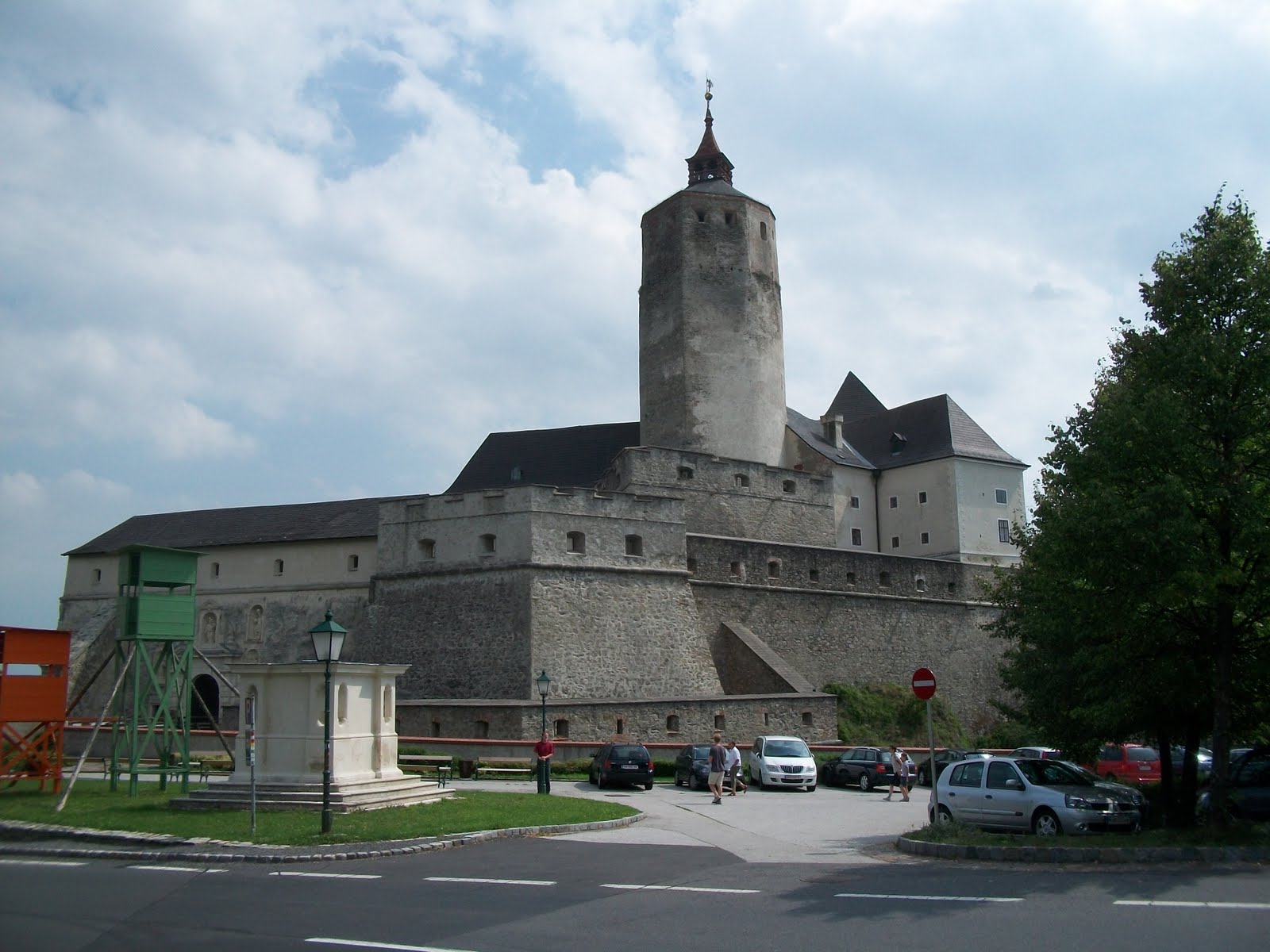
Austria has quite a few things that America does not have, castles are some of my very favorites. Forchtenstein castle is situated upon the top of hill over looking the Burgenland below. It is another example of Esterhazy influence. It was built in the Middle Ages and handed over to the Esterhazys in the 17th Century as a show of gratitude when the Esterhazy’s military obtained Munkacs land in Hungary.[1] The Esterhazys then remodeled the castle into a fortified residence. It has been a castle, the troops arsenal, the Esterhazy treasury and a fortified residence. The artifacts within show its dual purposes as an arsenal and residence.

As an arsenal this castle had a plethora of guns. Some were captured from the French and others were used against the Turks. However, being an American we see guns quite often since we constitutionalized the right to bear arms so they are not as exciting as some other pieces in the arsenal. I was however, extremely impressed by the glass grenades, which were used against the Turks. When our tour guide mentioned them I thought it was a mistranslation because I did not think grenades were invented until later. Then if they were glass, there’s no way they would have lasted over 300 years. However, me of little faith, there were glass grenades and now I’m left imagining how painful it would be, caught in its blast. Another very interesting piece is the execution chair, very different than the guillotine or the gallows, which take very little talent or skill to accomplish the job of the executioner. I believe an axe with a chopping block would be easier than the chair. For an execution at this chair think baseball. A home-run would be decapitation with the first swing. The chair itself has evidence of batters with low batting averages.

As a residence this castle has places to cook and places to eat. Most impressive however was the place to get one’s water. Happy Birthday will never be quite as spectacular again after hearing its echoes sung in the deep well of Forchtenstein Castle.

As we meandered home from the Alps and Forchtenstein Castle we found ourselves at yet another castle (something that would not happen in California). According to a sign, the Liechtenstein Dynasty built the Liechtenstein Castle in the 12th Century. It was destroyed by the Turks and then “re-built in 1873 and completed in the style of the period (historism [sic]).” This quote made me laugh a little because the Ring Strasse was built in this period, and the period’s style, Historicism, mimics past styles. So I wonder if the castle is mimicking castle styles, or how that works. So this castle that looks medieval, what we see today is in fact an “aspiring” medieval castle, built where one originally medieval castle stood.[2]

Even though much of the castle is re-built, and not all of it is indeed 12th Century, it is still pretty cool and older than many of our historical buildings in California. I am from the “Victorian Village of Ferndale” in California and its history of wealth boomed in the 1880s. This is one of our “old” towns. If comparing the age of Liechtenstein and Ferndale, the latter is a baby, born when the former was having its second hip-replacement surgery. Old has a whole different meaning in Europe. California has a Victorian Village, Austria has many castles.


[1] History of Forchtenstein Castle, http://kultur.esterhazy.at/en/forchtenstein-castle/history

[2] Nicholas Parsons, Vienna A Cultural History (New York: Oxford University Press, 2009), 208.

Thursday, August 12, 2010

Alpine Hike


Our first evening in the Alps welcomed us with rain and it was quite beautiful watching the clouds nestle in the valley below. The next morning was perfect: sunny but not too hot. When we set out in the morning we were not aware that we would be Professor Stuart’s most fit class. Destination: Habsburg Haus and back to the Raxbahn Station.

It was incredible to hike from one vista to the next. I loved the views that the crosses stared at all day long and the air was fresh and crisp. We made it to Otto House where Otto the cat greeted us to congratulate us to our first stop. We hung out with the cat for a while and then continued to our next stop. Our stops were not just benches placed every couple of miles for a rest, but they were full service, stocked with wine, beer and food—all the necessities for an alpine hike.

At our second stop is when my story becomes a little more personal. While the rest of our super-fit group finished up lunch I decided I would just get going, slowly so they would catch up with me. I set out and made it to the next vista and was surprised that my group was nowhere to be seen. I waited for a bit until I decided I went the wrong way and hurried my way back down to where I had seen my group last. Then I found the trail markers and decided I would pick a pace and not slow down until I was reunited with the rest of us or until I reached the Habsburgs House, whichever came first. I had no time to stop for photos which explains my pitiful photoalbum for this event. I passed other alpine hikers and asked if they had passed a group of Americans. I found the answer I was looking for and hoped I would have a minute or two to sit down before hiking back down. I reached the rest of us Americans just as they were walking up to the Habsburg Haus. I sat down flushed and sweating and feeling quite accomplished.

Then we headed down, on a new trail. We arrived back at the Raxbahn station, starving and in dire need of a shower. I did not have a towel in my room and asked the kitchen staff, “Darf ich ein Badtuch haben?” I did not annunciate my German well enough, so I tried English then he proceeded to mime using a towel to dry his back. We laughed as he handed me his towel and I went up to shower to pass the time before dinner.

This was a perfect weekend. I loved the hiking and the memories. It has reminded me how I would much rather get off my backside and raise my heart rate in nature’s beauty. Next summer I will summit Mount Shasta. This summer I will return home to Redding and summit Mount Lassen.

Wednesday, August 11, 2010

Eisenstadt


The middle destination of our road-trip today is significant in a number of historical veins: Habsburg, music and Jewish. Eisenstadt is a small village (population 14,000) in the Burgenland country of Austria. It is home to the Esterhazy family. This is a very prominent family within the Habsburg Dynasty with the wealth of land consisting at one point of 500,000 acres in Hungary and 50,000 acres in Austria. They acquired their wealth through the success of Charles VI with the system of estate capitalism, profiting from peasants. They were also lucky enough to make a very advantageous marriage to a Hungarian princess. Today the Esterhazys are the private owners of the Esterhazy Palace in Eisenstadt. The victors chose the High Baroque to celebrate the wealth and success of the Habsburgs.

Eisenstadt is home to a spectacular example of a Baroque church. Baroque is a product of Counter Reformation with an “in-your-face” sort of jab to Protestantism. The altars and frescoes are grand and distinctive emphasizing what makes the Catholics differ from the Catholics: the saints, Mary and the passion and suffering of Jesus. The Church in Eisenstadt boasts a wonderfully Baroque example of the ‘Stations of the Cross’ that wind through the cave-catacomb-like walls of the church. It was dark and cool in these caves, causing the hair on the back of my neck to stand up. I found myself in awe as my footsteps followed the steps, which were worn from centuries of pilgrimages to this site.
Another awe-inspiring room we entered was Haydn’s Mausoleum. The Esterhazy family was Haydn’s patron. Haydn was musically trained in Vienna and a contemporary of Mozart. There’s a great story about Haydn’s skull. When he first died a doctor stole his skull from the grave. He wanted to dissect it to find the music genius center of the brain and measure bone size of geniuses. Haydn’s skull was not reunited with the rest of his remains in the Haydn tomb until 1954.

Besides the journey of Haydn’s skull one of his compositions also made its way around a block or two. Haydn’s Hymn was first written and dedicated to Emperor Josef as God Bless the Emperor. Next it became the theme song to nationalism during the 1848 revolutions. Third it was picked up and sang by the Nazis, “Deutschland, Deutschland über alles.” Finally it became Germany’s National anthem however, it is illegal to sing the first two stanzas verses because of the implications of Fascism and Nazism. Next time I watch the Germans win the gold at the Olympics I will think of Haydn and his Hymn. Then my mind will probably meander over to thoughts about his skull and whether or not it is in fact Haydn’s actual skull that Eisenstadt has reunited with his skeleton or one that seems to fit.
However fun and exciting pilgrimages and composers’ tombs are, the object of my affections is the Jewish history of the city. In the 1700s Prince Esterhazy created protected communities known as Sheva Kehillot, Seven Parishes, for the Jews inside the cities of Eisenstadt, Mattersdorf, Deutschkreutz. Lackenbach, Korbersdorf, Frauenkirchen, and Kittsee. Prince Esterhazy granted Jews in these communities “all rights and facilities required by their religion” in addition to the right to govern their own communities. The protected Jewish community of over 500 inhabitants of Eisenstadt, known as Unterberg-Eisenstadt, lasted the longest and dissolved in 1938 under Nazi Occupation. It was one of the first communities the Nazis deported in April of 1938 and the rest of Unterberg was destroyed in the November Pogroms known as Reichskristallnacht. Today there are only two Jewish families, a small Jewish Museum and two Jewish Cemeteries to remind visitors of its once thriving Jewish community in Eisenstadt. We can see the remains of the Jewish community and the synagogue in the Museum.


Within the Jewish Museum and Unterberg we can see the few remains of the community’s Jewish history. The books and a few Synagogue artifacts represent the life of the community that used to be. Then there are the Nazi banners, the ghetto sign and anti-Semitic propaganda that represent the annihilation of the Jews. The tombstones in the cemeteries represent the individual Jews. I find the remnants of other tombstones that were used as tank blockades to be quite appalling. The Nazis even used the memory of deceased Jews as military apparatus in order to. In the Centralfriedhof in Vienna, there was also a huge pile of tombstones destroyed by Nazi Occupation as well. I read at the Jewish Museum in Vienna that the largest Jewish cemetery in Thesoloniki was bulldozed under Nazi Occupation. Even the deceased Jews, dead and buried, were not safe from the Nazis and their desecration. I also find the wording interesting: “destroyed by Nazi Occupation.” The passivity of the statement is quite telling: it says the Nazis did not commit the crimes but it was the occupation that is to blame. What is to blame the occupation or the Nazis?